
Carat Size Guide
Carat is a measure of weight, not size — but most people want to know how big a stone will look. Choose a shape and a carat weight to see its typical face-up dimensions, or enter measurements to estimate the carat weight. Calibrate your screen with a bank card to preview stones at actual size.
- Free to use
- No sign-up
- Runs in your browser
Carat size calculator
Diamond Size Charts
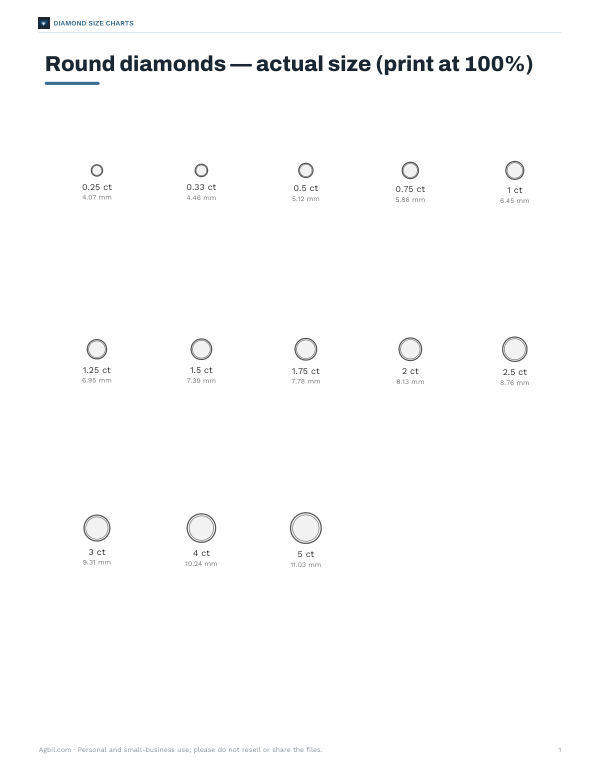
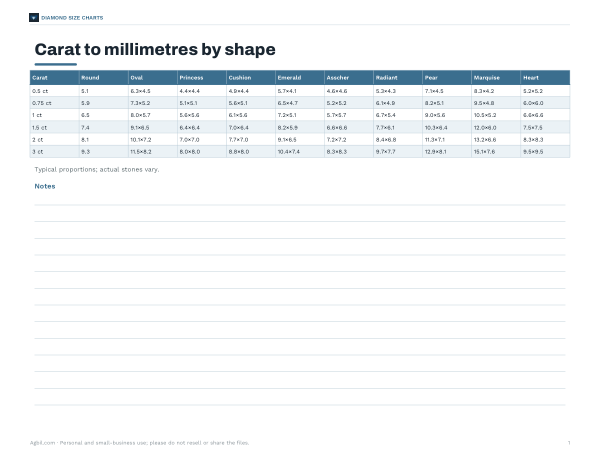
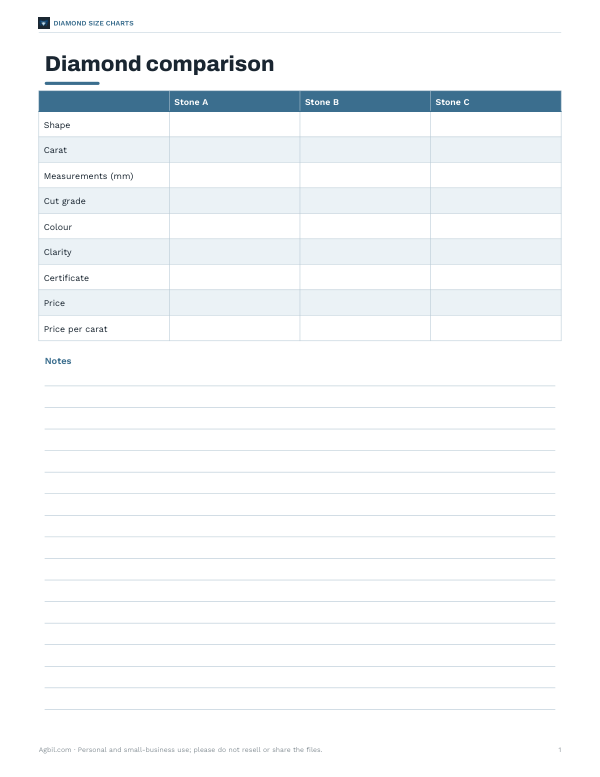
Printable diamond carat size charts at actual size (round and fancy shapes), a carat-to-mm table, a four Cs comparison worksheet and a ring shopping checklist.
- Round sizes (PDF)
- Carat to mm (PDF/XLSX)
- Four Cs worksheet (DOCX/PDF)
- Shopping checklist (PDF, DOCX)
Formats: PDF, XLSX, DOCX. Instant download after payment (link valid 72 hours, up to 5 downloads). AI-assisted: the templates were drafted with AI help and reviewed and laid out before publishing.
$3.00 USD, one-time 4 files · about $0.75 each
- Instant download
- 7-day refund
- Secure checkout by Stripe
7-day money-back guarantee. Full refund within 7 days of purchase, even after you download.
Free sample: Carat to MM Chart (PDF, 50 KB)
Full refund within 7 days — see the refund policy and license.
Free printables
Single sheets you can print right now, no sign-up. The full pack adds every sheet in one download plus the editable files.
 Printable Engagement Ring Shopping Checklist
Round diamond carat to mm chart
| Carat | Diameter (mm) | Carat | Diameter (mm) |
|---|---|---|---|
| 0.25 ct | 4.1 | 0.5 ct | 5.1 |
| 0.33 ct | 4.5 | 0.75 ct | 5.9 |
| 0.4 ct | 4.8 | 1 ct | 6.5 |
| 0.6 ct | 5.4 | 1.25 ct | 7.0 |
| 0.7 ct | 5.7 | 1.5 ct | 7.4 |
| 0.8 ct | 6.0 | 2 ct | 8.1 |
| 0.9 ct | 6.2 | 3 ct | 9.3 |
Diameters assume a well-cut round brilliant with a depth of about 61%. Shallow or deep cuts of the same weight look larger or smaller face-up.
Carat weight vs visible size
One carat is 0.2 grams. Because weight depends on volume, diameter grows only with the cube root of carat weight: doubling from 1 to 2 carats increases a round diamond’s diameter by about 26%, from roughly 6.4 mm to 8.1 mm — and the face-up area by about 59%. Shapes that are long or shallow, such as ovals, marquise and pears, spread their weight over a larger face-up area and can look bigger than a round of the same weight.
Estimation formulas
| Shape | Estimate (mm) | Typical L:W |
|---|---|---|
| Round | diameter² × depth × 0.0061 | 1.00 |
| Oval | L × W × depth × 0.0062 | 1.40 |
| Princess | L × W × depth × 0.0083 | 1.00 |
| Cushion | L × W × depth × 0.008 | 1.10 |
| Emerald | L × W × depth × 0.008 | 1.40 |
| Asscher | L × W × depth × 0.008 | 1.00 |
| Radiant | L × W × depth × 0.0081 | 1.25 |
| Pear | L × W × depth × 0.0059 | 1.60 |
| Marquise | L × W × depth × 0.0058 | 2.00 |
| Heart | L × W × depth × 0.0059 | 1.00 |
Gemmologists use shape factors like these to estimate the weight of a mounted stone that can’t be weighed. Results are typically within about 10% for normally proportioned stones; girdle thickness and cutting style cause the rest.
How to use the calculator
- Choose a shape.
- Pick “Carat → size” to see typical dimensions for a weight, or “Size → carat” to estimate weight from length, width and depth in millimetres.
- Calibrate your screen: hold a bank card to the screen and drag the slider until the grey card matches.
- Look at the actual-size preview, or hold a ring near the screen to compare.
Worked example
A 1-carat round brilliant is about 6.45 mm across. A 1-carat oval with a typical 1.4 length-to-width ratio measures about 8.0 × 5.7 mm, so it looks larger face-up because its outline covers roughly 10% more area. Going the other way, a round stone measuring 6.5 mm across and 4.0 mm deep is estimated at about 1.03 carats.
The four Cs
| C | What it means |
|---|---|
| Carat | Weight: 1 ct = 0.2 g, divided into 100 points |
| Cut | Proportions and finish, which control brilliance and face-up size |
| Colour | D (colourless) to Z (light yellow or brown) on the GIA scale |
| Clarity | From Flawless to Included, depending on inclusions and blemishes |
Prices jump at “magic” weights such as 0.5, 0.9, 1.0 and 1.5 carats; stones just under these weights can look almost identical for noticeably less money.
Points and fractions
| Term | Carat weight |
|---|---|
| 25 points | 0.25 ct (quarter carat) |
| 33 points | 0.33 ct (third carat) |
| 50 points | 0.50 ct (half carat) |
| 75 points | 0.75 ct |
| 100 points | 1.00 ct |
| Total carat weight (ctw) | Combined weight of all stones in a piece |
Jewellery listed as “1 ctw” may contain many small stones adding up to one carat, which looks very different from a single one-carat diamond — and costs much less.
Lab-grown and other gemstones
Lab-grown diamonds have the same density as natural diamonds, so the size-to-weight relationship is identical. Other gemstones have different densities: sapphires and rubies are heavier than diamond, so a one-carat sapphire looks smaller than a one-carat diamond, while lighter stones such as emeralds look larger per carat. The estimates here are for diamonds.
On the hand
How big a stone looks also depends on the finger and setting. On a size 4 finger a 1-carat round covers much more of the finger width than on a size 9. Halo settings add a ring of small stones that makes the centre look larger, while thin bands and high settings make stones look more prominent. Try paper cut-outs or the on-screen preview against your hand before deciding.
Privacy
Everything runs in your browser; only your screen calibration is saved locally.
Frequently asked questions
How big is a 1 carat diamond?
About 6.4–6.5 mm across for a well-cut round brilliant.
How many mm is 2 carats?
About 8.1 mm for a round brilliant.
Does a higher carat always look bigger?
Usually, but cut depth and shape matter; a shallow or elongated stone can look bigger than a heavier deep one.
How much does a carat weigh?
0.2 grams.
Which diamond shape looks biggest?
Elongated shapes like marquise, oval and pear usually look larger per carat.
What does ctw mean?
Total carat weight — the combined weight of all stones in a piece.
How big is a half-carat diamond?
About 5.2 mm across for a round brilliant.
Can I measure a stone in a setting?
Yes — measure the visible length and width and estimate depth; the result is approximate.
Is anything uploaded?
No, it runs in your browser.